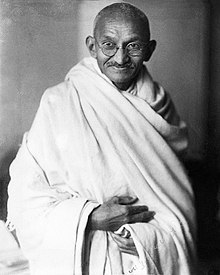
An eye for eye only ends up making the whole world blind.
Mohandas Karamchand Gandhi was an Indian lawyer, anti-colonial nationalist, and political ethicist, who employed nonviolent resistance to lead the successful campaign for India's independence from British Rule, and in turn inspire movements for civil rights and freedom across the world.
Here's a time line of Mahatma Gandhi:
October 2, 1869 - Birth of Mohandas Karamchand Gandhi
1883 - Gandhi and Kasturbai are married.
1885 - Death of Karamchand Gandhi, Gandhi's father
September 4, 1888 - ·Gandhi leaves for England to study law.
June 10, 1891 - Gandhi passes the bar exam in England.
1891-1893 - Gandhi fails as a lawyer in India.
April 1893 - Gandhi accepts commission to spend a year in South Africa advising on a lawsuit.
Spring 1894 - Gandhi elects to stay on South Africa, and founds the Natal Indian Congress.
Spring 1896 -Gandhi returns to India to collect his wife and children.
December 1896 - Gandhi returns to South Africa with his family.
October 1899 - Outbreak of Boer War (1899-1901) in South Africa. Gandhi organizes an ambulance corps for the British.
1901 - Gandhi returns to India to attend the Indian National Congress. G.K. Gokhale introduces him to nationalist leaders.
1901-1906 - Gandhi struggles toward Brahmacharya, or celibacy, finally ending his sexual activity in 1906.
1904 - Nationalists found the magazine the Indian Opinion, and soon print it on Gandhi's farm, the "Phoenix Settlement.
July 31, 1907 - The Boer Republic Transvaal, now under the control of the British, attempts to register all Indians as members; Gandhi and others refuse to register. Their resistance efforts mark the first use of nonviolent non-cooperation by the Indian minority in South Africa, soon calledsatyagraha, or "soul-force."
October 10, 1908 - Gandhi is arrested again, spends a month in jail.
1909 - Gandhi travels to London, pushing for rights of South African Indians. The Transvaal registration law is repealed.
November 13, 1913: - Indians in Natal and Transvaal, under Gandhi's leadership, march peacefully in protest of a racist poll tax and marriage laws. The marches continue through the winter.
June 30, 1914 - ·Gandhi and Smuts, the Prime Minister of the Transvaal, reach an agreement, ending the protests.
July 18, 1914 - Gandhi sails to England.
August 1914 - Gandhi arrives in England, just at the outbreak of World War I(1914-1918).
January 9, 1915 - Gandhi returns home to India, and receives a hero's welcome.
1909 - Gandhi travels to London, pushing for rights of South African Indians. The Transvaal registration law is repealed.
May 25, 1915: - Gandhi and his followers found Satyagraha ashram, the religiously-oriented communal farm where Gandhi, his family, and his followers will live.
April 6, 1919 - Nationalists hold a hartal, or day of fasting and prayer, in protest of the Rowlatt Act, which drastically curtails civil liberties in India
April 13, 1919 - Amritsar Massacre; Under General Dyer, British troops slaughter Indian protesters.
August 1, 1920 - Gandhi calls for a period of non-cooperation across India.
March 10, 1922 - Gandhi is arrested for sedition.
March 1922-January 1924 - Gandhi remains in prison.
1924-1928 - Gandhi avoids politics, focusing his writings on the improvement of India.
1925 - Despite his long absence from politics, Gandhi becomes President of the Indian National Congress.
February-August 1928 - Residents in the district of Bardoli protest high rents using methods of non-cooperation inspired by Gandhi.
January 26, 1930 - Gandhi publishes the Declaration of Independence of India
March 2, 1931 - Gandhi warns the Viceroy of his intention to break the Salt Laws..
March 12-April 6, 1931 - Gandhi leads his Salt March to the sea.
May 5, 1931 - Gandhi is arrested for violating the Salt Laws; non-cooperation movements break out across India.
January 1931 - British government yields to protests, releases all prisoners, invites a Congress representative to Britain for a Round Table Conference (the Congress asks Gandhi to be this representative).
Autumn 1931 - Gandhi participates in the Round Table Conference in Britain.
December 28, 1931 - Gandhi returns to India.
January 4, 1932 - Gandhi is arrested for sedition, and held without a trial.
September 20-25, 1932 - Gandhi fasts in prison to protest the treatment of untouchables
1934-38 - Gandhi avoids politics, travels in rural India.
1935 - Government of India Act passes British Parliament and is implemented in India; it is the first movement toward independence
September 1939 - World War II begins, lasting until 1945.
March 22, 1942 - Sir Stafford Cripps arrives in India, presenting to the Indian National Congress a proposal for Dominion status (autonomy within the British Commonwealth) after the War.
August 8, 1942 - The Indian National Congress rejects the Cripps proposal, and declares it will grant its support for the British war effort only in return for independence.
August 1942 - Congress leaders are arrested; Gandhi is imprisoned in the Aga Khan's palace.
September 1939 - World War II begins, lasting until 1945.
March 22, 1942 - Sir Stafford Cripps arrives in India, presenting to the Indian National Congress a proposal for Dominion status (autonomy within the British Commonwealth) after the War.
August 8, 1942 - The Indian National Congress rejects the Cripps proposal, and declares it will grant its support for the British war effort only in return for independence.
August 1942 - Congress leaders are arrested; Gandhi is imprisoned in the Aga Khan's palace.
itish Commonwealth) after the War.
August 8, 1942 - The Indian National Congress rejects the Cripps proposal, and declares it will grant its support for the British war effort only in return for independence.
August 1942 - Congress leaders are arrested; Gandhi is imprisoned in the Aga Khan's palace.
"Generations to come will scarce believe that such a one as this ever in flesh and blood walked upon this earth"
-- Albert Einstein
If you have time, you should read more about this incredible human being
on his
Wikipedia entry.